



Sep 22, 2026
Complex Clinical Trials: From Design to Implementation

Complex Clinical Trials: From Design to Implementation
Efficiences, Challenges, and Trade-offs
Between 2012 and 2020, the average Phase III protocol grew from collecting about 929,000 data points to roughly 3.56 million, a near fourfold rise.
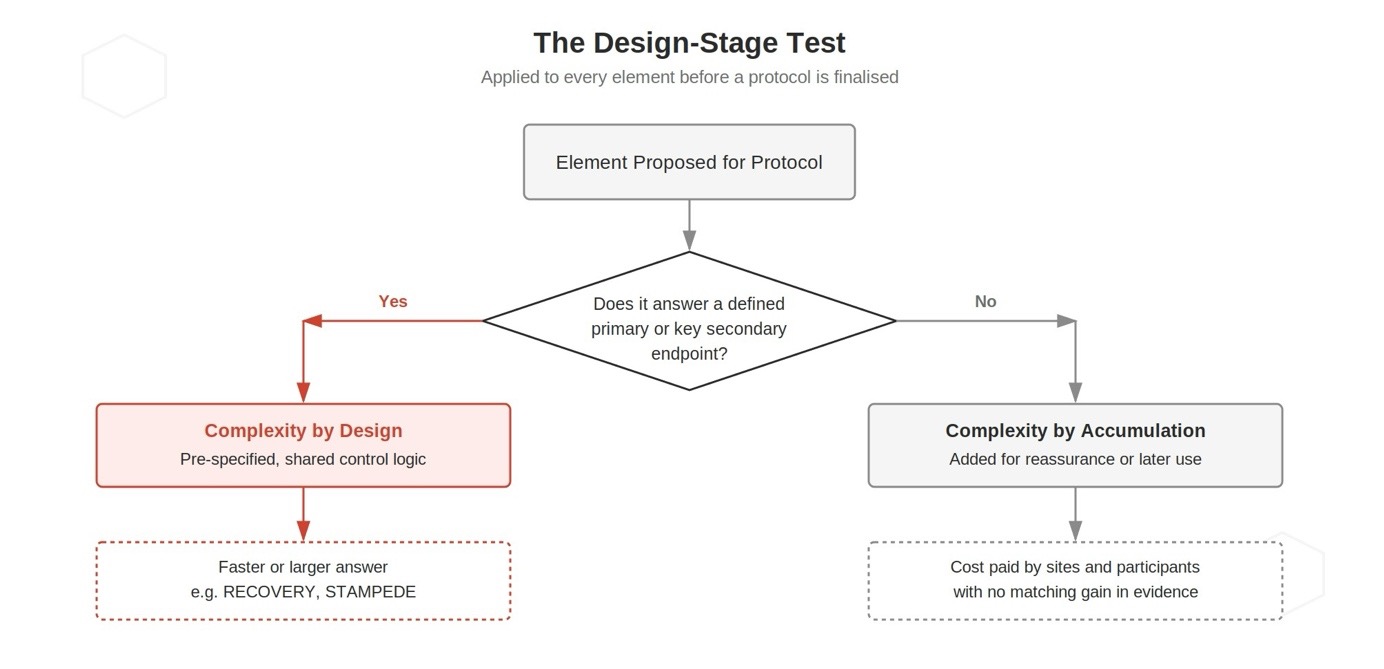
This matters for anyone designing or running a trial. Some complexity is chosen on purpose, to answer a defined question. That kind earns its cost. Other complexity accumulates by default, where an element stays in because removing it feels riskier than keeping it. Sites and participants pay for that complexity, and the trial rarely gets much back for it.
This article covers how to tell the two apart, where added complexity has paid off in real trials, and what it costs to run well.
What Makes a Trial Complex
A trial's complexity comes from how much its design asks beyond a standard two-arm, fixed-endpoint study: more treatment arms, more endpoints, more decision points built into the protocol. That complexity comes from two different sources, and the source is what determines whether it's worth the cost.
A platform trial that shares one control arm across several treatments is complex by design. So is an adaptive design that changes its randomisation ratio as interim data arrive. In both cases, the complexity was chosen to answer more within a single study, and it is written into the protocol before the first participant enrols.
Complexity by accumulation builds differently: across successive protocol drafts, each addition reasonable on its own, an extra blood draw here, an exploratory biomarker there. Non-core procedures, meaning those that do not support a primary or key secondary endpoint, made up about a quarter of all procedures in the typical Phase III protocol. A 2025 analysis by TransCelerate and Tufts CSDD found that 77% of this non-core data still reaches the clinical study report, much of it collected for possible future use and never actively analysed.
Neither kind is a flaw by itself. The question worth asking of every element, at the design stage, is: does this help answer the primary question, or is it here for reassurance?
What the Data Shows About Complexity and Duration
A 2024 machine-learning analysis of more than 16,000 industry-sponsored trials put a number on the relationship this article has been describing. Researchers scored each trial's design on a 0-to-100 Trial Complexity Score, built from its number of endpoints, eligibility criteria, sites, countries, and arms. A 10-point rise in that score corresponds to roughly a third longer trial duration, holding across Phase I, II, and III.
The average score has risen more than 10 points over the past decade, with Phase I trials showing the steepest increase as more endpoints get added earlier in development.
The more useful finding is what happens inside a single indication. In major oncology indications, complexity scores for individual trials range from the 20s to the 90s.
Where Complexity Earns Its Place
If you're deciding whether a platform or adaptive design is worth the added cost, this is what that choice has bought other trials. Master protocols make the clearest case: in a platform trial , participants with one condition are randomised across several treatment arms against a single shared control, and arms can be added or dropped as interim data arrive. Two examples show what that delivers.
RECOVERY , the UK's COVID-19 platform trial, ran as a randomised, open-label design with one endpoint, 28-day mortality, and minimal data capture. It showed dexamethasone cut mortality in ventilated patients from 41.4% to 29.3%. Because the shared control let each new treatment arm be tested without rebuilding the comparison group from scratch, RECOVERY answered several questions at the speed a single one would normally take.
STAMPEDE , a multi-arm, multi-stage platform trial in prostate cancer running since 2005, works on the same principle. The NIHR estimates that running the same set of questions as separate two-arm trials would have taken more than 40 years.
Both trials moved faster, and exposed fewer participants to inferior treatments, than a run of standalone trials would have for the same set of related questions. That is the return on complexity chosen by design.
What Complexity Costs
Both the kinds of complexity discussed below have a cost involved. Design costs are paid upfront and planned for. Accumulation costs show up later, in amendments.
Design cost, paid upfront and planned for
A platform trial's shared control needs an independent monitoring board and stopping rules agreed before the first analysis, which is why RECOVERY used fixed rather than response-adaptive randomisation, to keep that load manageable. Not all design complexity is statistical. A trial can keep a conventional two-arm structure and still be complex to run, if the choice is about where and how the trial operates rather than how it is analysed.
Decentralised trials trade one cost for another: the FDA's 2024 guidance and ICH E6(R3) both allow trial activity at a participant's home, lowering travel burden but raising the sponsor's burden in data integrity and oversight across many more locations. Which trade-off is worth it depends on what's limiting the trial: recruitment, or control over on-site assessment.
Accumulation cost, hidden until the amendment
Protocols with at least one substantial amendment carry 25% more endpoints and 16% more eligibility criteria than protocols without one. A substantial Phase III amendment costs a median of US$535,000 , and most protocols need at least one. Each addition looks reasonable alone; the combined effect, longer visits, more deviations, shows up only once the trial is running.
How to Spot Trial Complexity
Four checks distinguish an element that's earning its place from one that's been added by default.
Link to the statistical analysis plan. An element tied to a primary or key secondary endpoint in the SAP is answering the trial's main question. One that isn't referenced there is not.
Pre-specified analysis. An element with a defined analysis plan is testing something. An element without one is exploratory, which is the pattern behind the finding that 77% of non-core data still reaches the clinical study report unanalysed.
Point of entry. An element specified during protocol design went through review. An element added later, after a sponsor call or site feedback, usually didn't.
A defined use for the output. An element earns its place when a specific decision depends on its result. Without that link, the data has no defined function in the trial.
An element that fails more than one of these checks is worth reviewing before the protocol is finalised, not after an amendment.
Making the Call in Practice
ICH E6(R3) makes this a regulatory requirement, not just good practice. The guideline requires sponsors to identify "critical-to-quality" factors, the processes and data points that most affect participant safety and the reliability of the results, and to build quality into the trial from the start rather than inspecting it in afterward.
That review has two natural points of application. The first is before the protocol is finalised, when removing an element costs nothing. The second is at each amendment, when it's easy to add scope and easy to skip asking the same question of what's already there.
DiagnoSearch's clinical operations and clinical data management teams run these checks with sponsors at the protocol design stage, before a single site is activated, and again at each amendment. If you're weighing a platform, adaptive, or decentralised design for your next study, connect with our team at contactus@diagnosearch.com , and our team will work through the trade-offs with you.