



Sep 7, 2026
Direct Data Capture (DDC): Enabling the Next Evolution of Clinical Data Management
Authored by: Uttara Ginde
Clinical research has changed traditional methods to decentralized trial models, digital health technologies, and growing expectations for faster, high-quality data. As a result, Clinical Data Management (CDM) is evolving from a function focused on primarily on data cleaning and reconciliation into a strategic discipline focused on data quality, traceability, and timely decision-making.
Electronic source data (eSource), electronic patient-reported outcomes (ePRO), electronic clinical outcome assessments (eCOA), wearable devices, laboratory systems, and imaging platforms are complementary capabilities that contribute to a broader digital clinical trial ecosystem [1][3][4]. Direct Data Capture (DDC) should be clearly distinguished from related digital technologies. In the context of clinical trials, DDC system, when appropriately designed and governed, may fulfil the role of source documentation or contribute to the participant's medical record. DDC does not inherently require a separate medical record for the same information to be maintained; copies or relevant records generated through DDC may be retained as part of the medical record, as applicable.
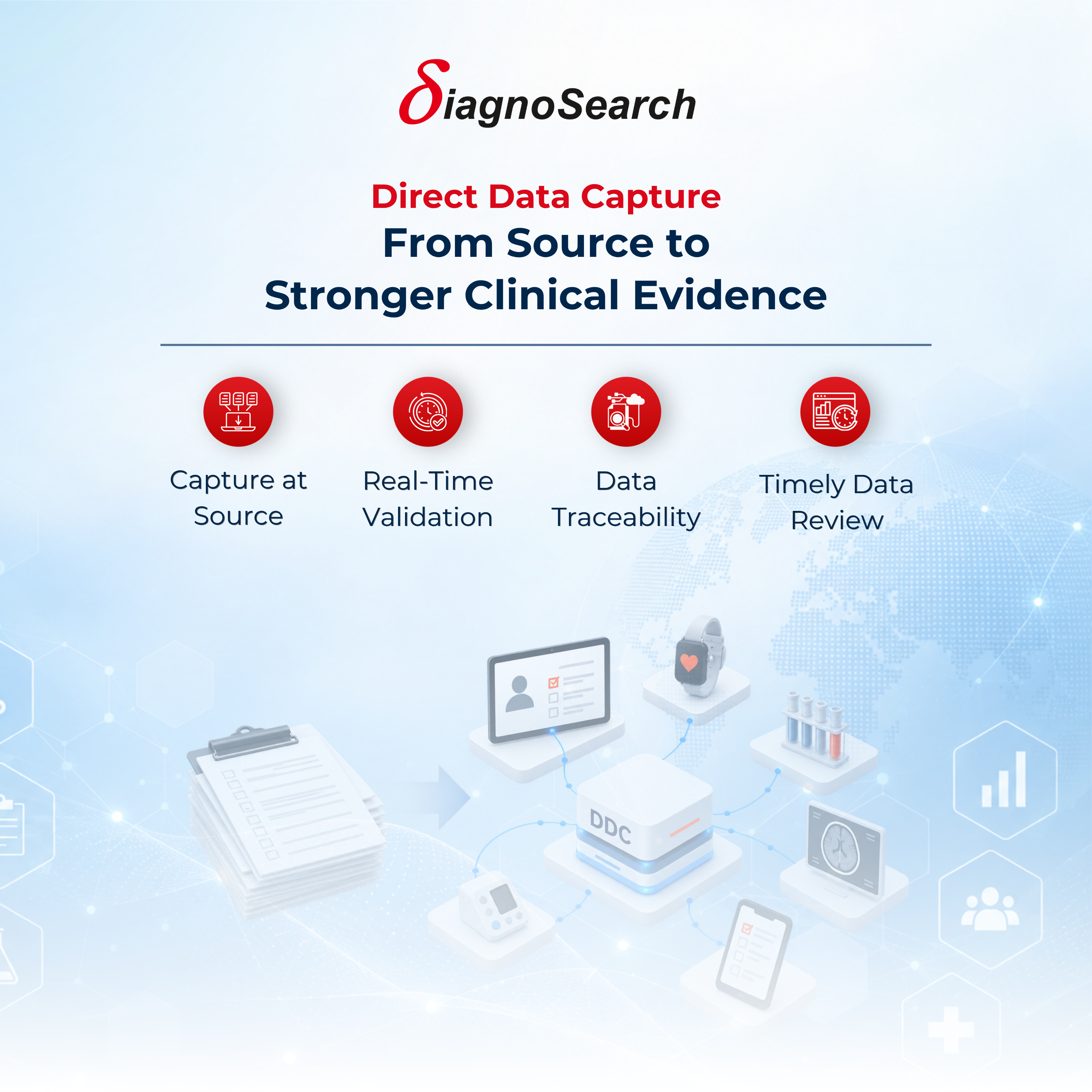
DDC is an important enabler of this transformation. DDC refers to the electronic capture of protocol-required clinical trial data closer to the point of source generation, reducing dependence on manual transcription between source records and Electronic Data Capture (EDC) systems [1][2]. Facilitating data flow in an integrated DDC-EDC system can improve data timeliness, reduce transcription-related discrepancies, strengthen data traceability and assist in real-time data review. By capturing data directly at the point of collection, DDC can also reduce or eliminate the need for maintaining separate paper records for the same information, where appropriate.
TRADITIONAL DATA CAPTURE Multiple steps • Greater transcription risk | DIRECT DATA CAPTURE (DDC) Closer to the source • Timely, higher-quality data |
|---|---|
▤ Manual transcription Information re-entered | ▰ DDC Real-time validation |
↓ | ↓ |
▱ EDC system Data entered electronically | ▱ EDC system Integrated data flow |
↓ | ↓ |
⌕ Data review Queries and reconciliation | ✓ Timely data Ready for review |
MORE STEPS • TRANSCRIPTION RISK • POTENTIAL DELAYS | FEWER STEPS • IMPROVED DATA QUALITY • FASTER REVIEW |
From a Clinical Data Management perspective, the primary value of DDC is improved data capture quality and operational efficiency. By reducing manual transcription steps and incorporating built-in checks that run in real time at the point of data capture, DDC can help identify missing fields, out-of-range values, and logical inconsistencies as they occur, thereby reducing certain data discrepancies and contributing to cleaner datasets. Earlier availability of higher-quality data can also support more timely review by Clinical Data Managers, Medical Monitors, and study teams [2], facilitating faster identification and resolution of potential issues and supporting more efficient study oversight and trial timelines.
DDC can also improve query management by enabling real-time validation checks, required fields, and consistency controls during data entry. However, DDC does not eliminate all data queries, as clinical judgement, protocol interpretation, safety review, and incorrect source information may still require investigation.
The role of DDC is also aligned with Risk-Based Monitoring (RBM) approaches, which focus oversight on critical data and processes rather than exhaustive verification [5]. By improving traceability and access to timely information, DDC can support more targeting monitoring strategies.
As clincial trials increasingly incorporate ePRO, wearables, remote monitoring, and external data sources, interoperability becomes essential. These data streams may connect with clinical systems through APIs or data platforms, but such integrations represent broader digital data connectivity rather than DDC alone [3][4].
DDC also provides a stronger foundation for advanced analytics by improving data availability and structure. However, artificial intelligence, predictive analytics, and automated risk detection require additional analytical platforms, validated methodologies, governance frameworks, and operational processes. DDC enables better data access; it does not independently deliver these capabilities [6][7].
Direct Data Capture represents an important step toward a more source-centric model of clinical research. Its true value lies in capturing the right data at the source, improving traceability, reducing the need for manual transcription and duplicate entry, and enabling faster access to reliable information.
As clinical trials become more decentralised and data-driven, organizations that strategically implement DDC alongside strong interoperability and quality frameworks will be better positioned to achieve improved data quality, operational efficiency, and regulatory readiness.
References
U.S. Food and Drug Administration (FDA). Guidance for Industry: Electronic Source Data in Clinical Investigations . 2013.
Clinical Ink. Direct Data Capture (DDC) in Clinical Research. Available at: https://www.clinicalink.com/technology/direct-data-capture-ddc/
TransCelerate BioPharma Inc. Decentralized Clinical Trials Recommendations. 2022.
Clinion. What is eSource in Clinical Trials? Available at: https://www.clinion.com/insight/what-is-esource-in-clinical-trials/
TransCelerate BioPharma Inc. Risk-Based Monitoring Methodology Recommendations. 2021.
Tufts Center for the Study of Drug Development (CSDD). Impact of Digital Technologies on Clinical Trial Efficiency. 2022.
European Medicines Agency (EMA). Reflection Paper on Expectations for Electronic Source Data and Data Transcribed to Electronic Data Collection Tools in Clinical Trials.