



Nov 18, 2026
What Is IWRS in Clinical Trials and Why Does It Matter?

An interactive web response system (IWRS) is a web-based system used to manage participant randomisation and investigational product assignment and supply. At a randomisation visit, authorised site staff enter or confirm the required information, and the system applies the study’s configured rules to issue an allocation and, where applicable, assign medication kits.
IWRS describes the web interface. Interactive response technology (IRT) is the broader term, covering web and telephone-based systems. Randomisation and trial supply management (RTSM) describes the functions these platforms perform. The terms often overlap in practice.
For sponsors and CRO study teams evaluating an IWRS clinical research service, the central question is whether the system translates the protocol into the right decisions at each visit. A working randomisation screen is only one part of that assessment. Site mappings, supply rules, access permissions and data transfers can each affect what happens to a participant.
How IWRS supports randomisation and blinding
The study statistician specifies the randomisation method, allocation ratio and any stratification factors. The IWRS implements that design through an approved randomisation schedule or a programmed algorithm, depending on the method. A well-configured IWRS clinical research service helps ensure that these randomisation requirements are implemented in accordance with the approved study design.
In a stratified permuted-block design, participants are allocated within the relevant stratum. An adaptive method may use a different allocation process. Describing every IWRS as issuing the next number from a single list misses these differences.
The purpose of stratification is to promote treatment balance within selected groups. It does not guarantee equal numbers in every subgroup at every point during recruitment. Almac’s explanation of randomisation methods in IRT illustrates how central, participant-stratified and site-stratified schedules work.
Allocation concealment and blinding need separate attention. Concealment prevents staff from knowing the next assignment before randomisation. Blinding limits knowledge of the assigned treatment afterwards. An open-label study can use IWRS while still concealing upcoming allocations.
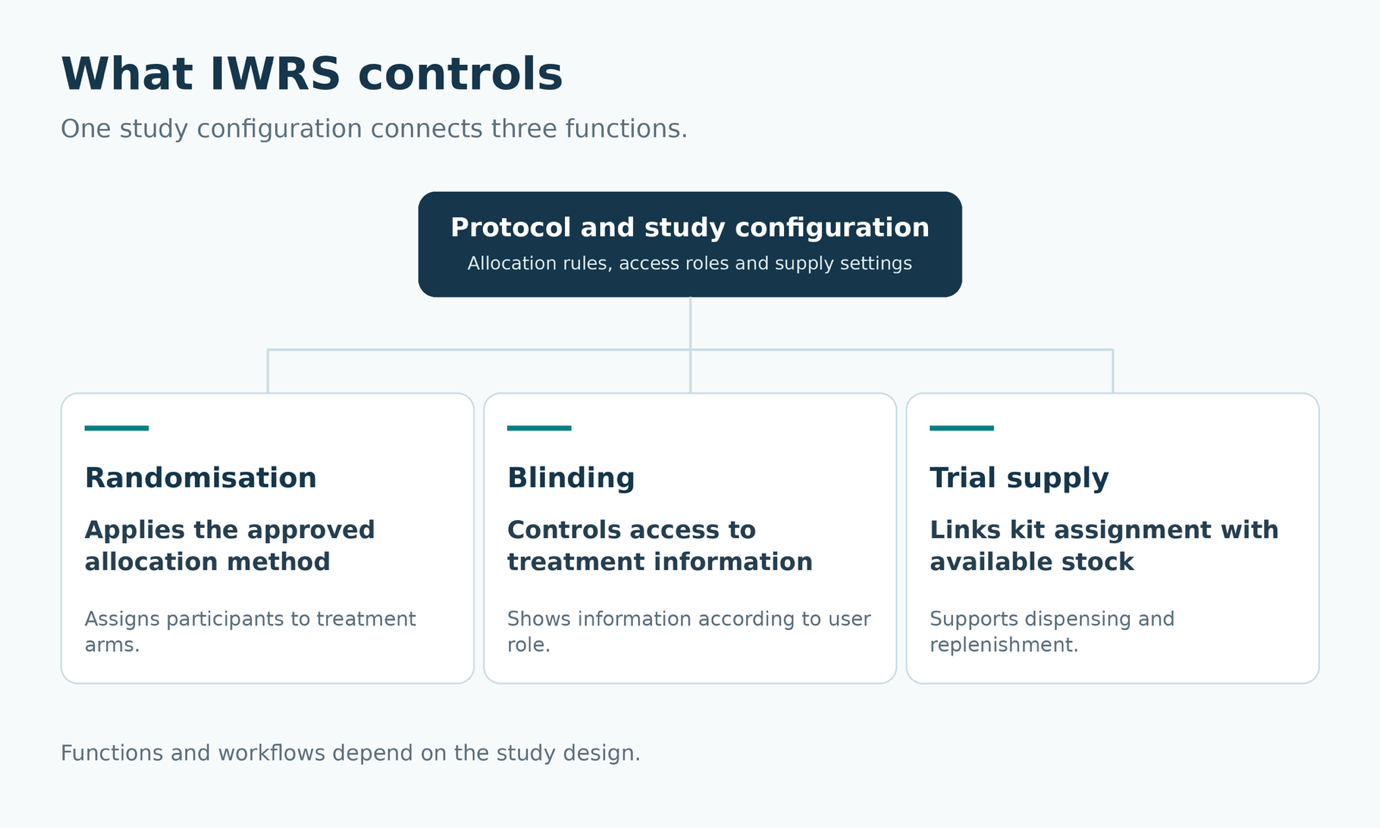
In a blinded trial, kit identifiers should not reveal treatment to blinded users. The underlying kit-to-treatment mapping still exists, with access restricted to authorised roles. Some site personnel, such as an unblinded pharmacist, may legitimately know the treatment.
Block sizes also need protection. Variable block sizes can reduce predictability, but they cannot guarantee that allocations will never be inferred. Study teams should review site-facing screens, notifications and reports for information that could reveal allocation patterns.
Emergency unblinding needs a tested route and a backup if the system is unavailable. EMA’s IRT-specific guidance says sites’ ability to unblind should be verified before investigational product is administered.
How IWRS manages investigational product supply
IWRS can connect participant visits with kit assignment and stock replenishment. A typical workflow records a depot shipment, requires the site to confirm receipt, then makes eligible kits available for dispensing. Resupply may use stock thresholds, projected visit demand or a combination of rules. Almac describes this inventory management workflow from shipment through kit assignment. These capabilities form an important part of clinical trial services, helping coordinate investigational product availability with participant visits and treatment schedules.
Expiry controls require more thought than checking whether a kit is in date on the dispensing day. It must remain usable for the period the participant is expected to take it.
A do-not-dispense rule sets the point before expiry when a kit can no longer be assigned. Its configuration should reflect the dosing schedule, quantity supplied, visit windows and any relevant in-use shelf life. Perceptive’s discussion of supply expiry controls distinguishes this from do-not-ship rules, which account for transport and subsequent use.
For example, a kit containing 28 days of treatment needs sufficient remaining shelf life for that course. A participant allowed to return late may need further supply planning. A rule based only on the nominal visit interval can miss that risk.
The opposite setting can also cause problems. An unnecessarily long restriction may exclude usable stock and increase replacement shipments. Kits blocked from assignment are not automatically written off. Oracle’s lot and expiry documentation shows how shipping, inventory-counting and dispensing cut-offs serve different purposes.
As a practical build review, teams should walk through a delayed visit, a near-expiry kit and a stock shortage. Check which kits remain assignable, when replenishment occurs and what the site sees when no suitable kit is available.
How IWRS fits alongside CTMS and EDC
IWRS, a clinical trial management system (CTMS) and electronic data capture (EDC) serve different purposes. Oracle’s CTMS documentation describes operational functions such as site management, monitoring visits and payments. IWRS handles allocation and supply transactions. EDC captures the clinical data required for the study.
The following are examples of possible interfaces, rather than a standard configuration for every trial.
| System | Main role | Possible exchange with IWRS |
|---|---|---|
| CTMS | Study and site operations | Approved site status sent to IWRS and recruitment counts returned |
| EDC | Participant clinical data | Eligibility or stratification data sent to IWRS and allocation or dispensing data returned |
| Depot system | Physical inventory and shipment fulfilment | Shipment requests received from IWRS and dispatch information returned |
Integration can reduce duplicate entry, but it does not make discrepancies impossible. Incorrect field mappings, delayed transfers and failed messages can still produce inconsistent records.
A useful interface specification identifies the authoritative source for each shared field, transfer timing, error handling and reconciliation responsibilities. Testing should include rejected messages and later corrections, as well as successful transfers.
For stratification data held in both IRT and EDC, EMA calls for verification or reconciliation of important data. Its guidance also says UAT should test every combination of user-entered stratification factors. Waiting until database lock to investigate an allocation-related mismatch may leave the study team discovering a recurring problem long after it began.
What regulators expect from IWRS
The regulatory concern is whether the system is fit for its intended use and whether its records can support reconstruction of the trial. The FDA’s October 2024 electronic systems guidance recommends risk-based validation before use. Validation should cover study-specific configurations, customisations, data transfers and interfaces. Later changes need documented assessment and validation according to risk.
For an IWRS build, the reviewable evidence should connect approved requirements to testing and release decisions. This includes the randomisation specification, relevant vendor validation evidence, study-specific UAT, resolution or assessment of defects, and records of subsequent changes. A vendor’s platform validation does not, by itself, demonstrate that a particular study configuration is correct.
ICH E6(R3), adopted at Step 4 on 6 January 2025, addresses both investigator readiness and data governance. Annex 1, section 2.11 says investigators should be able to unblind without undue delay or hindrance in an emergency. Section 4.1.4 says planned and unplanned unblinding should be documented, with unplanned unblinding assessed for its effect on trial results.
These provisions support a practical release decision: can the team show that the configured system performs its intended tasks, protects restricted information and supports timely clinical decisions?
What a documented configuration error teaches study teams
A dasotraline trial in adults with binge eating disorder shows how site configuration can undermine the intended randomisation design. According to the published statistical analysis plan, section 6.1.5, the team discovered on 20 July 2017 that sites had been linked to incorrect US regions in the IRT system. By then, 137 participants from 35 sites had been randomised. The plan states that 44 sites were screening participants and that all 44 had incorrect regional links.
The investigation traced the problem to unexpected behaviour in a region-selection dropdown within a third-party development tool. The sponsor amended the protocol and IRT specification to remove regional stratification, with the reasoning and analytical handling documented in the plan.
This case supports a broader testing approach than checking whether a participant receives an allocation. For studies that use regional strata, compare configured site-to-region mappings with the approved site list. Test what happens when sites are added or amended. Check that an administrative update cannot silently alter an existing mapping.
How to handle errors once the trial is live
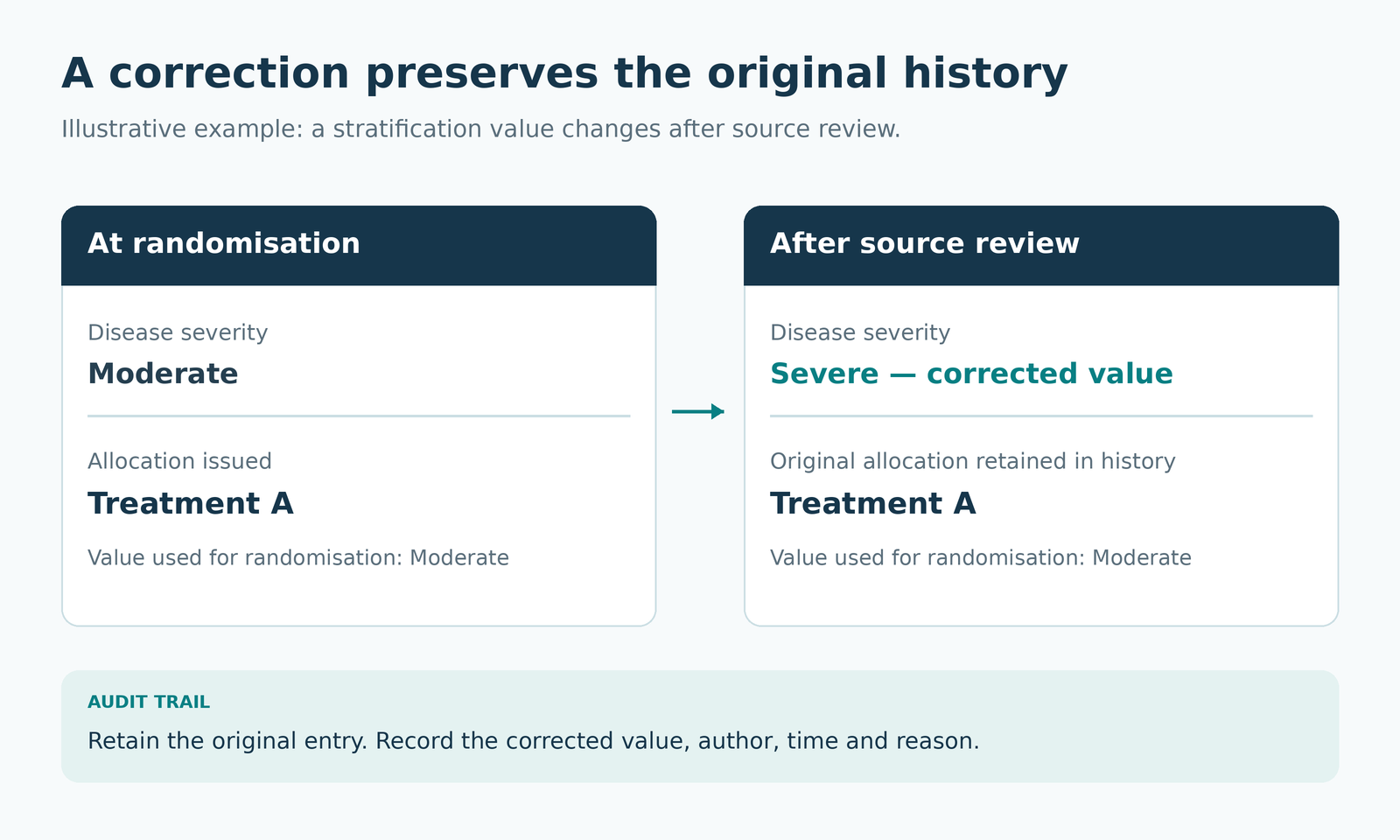
When an allocation-related discrepancy appears, the first task is to establish what happened. Distinguish the source value, the value entered or transferred to IWRS, the allocation issued and any product dispensed. Clinical and supply teams should assess immediate participant implications while the statistician assesses the randomisation and analysis implications.
A corrected clinical value and the value used for randomisation may both need to be retained. Correcting a data field is different from retrospectively changing a treatment allocation. Any proposed change needs an authorised process that preserves the original record and explains the correction.
ICH E6(R3), Annex 1, section 2.12.2 supports traceable corrections that do not obscure the original entry. An audit trail should show the history of a correction. The existence of a correction does not itself invalidate that history.
For study teams, this makes ownership as important as configuration. Agree who investigates discrepancies, who authorises changes and who reviews their statistical consequences. A system can flag an exception, but the study needs a defined process for resolving it.
DiagnoSearch provides IWRS clinical research services covering specification development, configuration, randomisation, kit allocation, inventory management, UAT support and user training. These activities complement broader clinical trial services by connecting randomisation, investigational product management and study-specific operational requirements. Its service page reports experience across more than 50 studies. Sponsors planning a new build can discuss these requirements alongside the trial’s data management and biostatistics needs.
FAQ's
What role does IWRS play in clinical trial design and management?
IWRS translates the approved study design into operational processes for participant randomisation, treatment allocation and investigational product management. It helps ensure these processes follow the protocol throughout the trial.
How does IWRS support clinical trial operations?
IWRS helps coordinate participant enrolment, randomisation, treatment allocation and medication supply across clinical trial sites. These functions support the broader clinical operation services required for effective study execution.
What should sponsors consider when selecting an IWRS service provider?
Sponsors should assess the provider's experience in randomisation, system configuration, inventory management, validation, UAT, system integration and user training. Experience coordinating with clinical operations and biostatistics teams is also important.
Is IWRS in clinical trials is required for each study?
No. The need for IWRS depends on the study design, randomisation requirements, treatment allocation process and investigational product supply complexity. Simpler studies may use alternative processes, while complex or multi-site trials often benefit from an IWRS platform.
How does IWRS help maintain data integrity in clinical trials?
IWRS supports data integrity through controlled user access, documented randomisation and dispensing transactions, audit trails and validated system configurations. These controls help maintain traceability and support the investigation of discrepancies.